

Avishekh Jiku
There has been conspiracies to postpone the general elections in Bangladesh. Certain political and Islamic parties are creating complications for the possible elections in February by demanding elections under the proportional representation or PR system. However, due to the PR system, instability in the country may increase, as the recent events in Nepal have clearly shown. However, many political parties including Jamaat-e- Islami, NCP, Islami Andolon Bangladesh, Communist Party are advocating for voting under the proportional system. The Jatiya Party, an ally of the Awami League, has also joined in the clamor.
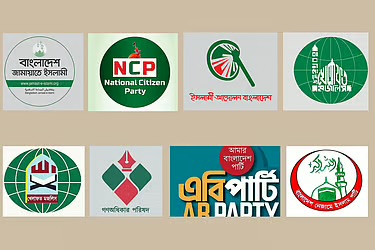
Many in Bangladesh believe that the proportional representation system prevents dictatorship on the one hand and on the other hand, this system also ensures that the public opinion of the voters is reflected. Therefore, leaders of Jamaat-e-Islami, NCP,AB Party and Gana Odhikar Parishad are vocal in favor of PR voting. But no one is concerned about the fact that elections under the PR system can create instability in the state.
Moreover, there is also a question about how the election system can be changed without amending the constitution.
Proportional representation is a complex issue. In this system, seats are distributed proportionally to the votes received by each political party. If a party receives 10 percent of the total votes cast, then that party will receive 10 percent seats in parliament proportionally. Many people believe that in this system, every vote cast in an election is used and each vote represents the parliament equally. Moreover, seats in parliament are distributed based on the number and rate of votes cast in an election. This system of election system is in operation in 91 countries in the world. Voting is held in proportional form in many countries of the developed world, including two countries in South Asia and Europe.
Although the fascist forces have been defeated, militancy and fundamentalism are on the rise in Bangladesh. That trend has increased a lot during the interim government’s tenure. Dr. Muhammad Yunus’s rule has seen the rise of fundamentalists. The poison of bias in recently concluded university elections has returned in a new guise. Instead of inclusive elections, state-run biased elections are reminiscent of that fascist regime.
The PR system is not suitable in the current socio-economic, geographical and political situation of Bangladesh. The people, of course have the right to know who or what person is being elected as their representative and sent to the parliament by voting. But under the proposed PR system, there is no clear opportunity for the people to know which person is being elected.
In connection with forthcoming parliamentary elections in Bangladesh, Dr. Yunus has said that ‘The national elections to be held in February are not just a general election, it is a foundational election, through which the path of Bangladesh’s future will be determined. Therefore, the fundamental reforms must be finalized in advance before the elections. At the same time, it must be kept in mind that there is no alternative to holding elections in the first half of February.
But by talking about reforms, a confusion is being created about that election. Different political parties in Bangladesh have different opinions about reforms. That is why the PR method is coming up. But there is always a fear about the stability of the government if this method of election is used. The government formed through the PR system would not be stable one because no political party in Bangladesh can achieve a single majority if this method of election is used. Advocate Syed Moazzem Hossain Alal, advisor to BNP Chairperson and former Prime Minister Begum Khaleda Zia, said, ‘Coalition governments have been formed repeatedly in Nepal because no single party could achieve a majority. The PR (Proportional Representation) system of election is one of the reasons for the mass uprising in Nepal. Many political analysts in Bangladesh believe that the current situation in Nepal has clearly shown the dangers of the PR system. They believe that the PR system is largely responsible for the current crisis in Nepal.
Yet fundamentalists are vocal in demanding elections under the PR system in Bangladesh. Syed Muhammad Rezaul Karim, the Amir (Charmonair Pir) of Islami Andolan Bangladesh, said, ‘If elections are held under the proportional representation system, every voter will be evaluated. ‘Dr. Riazul Islam Riaz, the Sylhet Metropolitan President of Islami Andolan Bangladesh, said, ‘To strengthen the governance system of the people of the country and to ensure that the opinions of the voters are reflected, the next national parliament elections must be held by ensuring the proportional representation system. ‘Nahid Islam of the NCP is also demanding elections under the PR system. The Jatiya Party has also joined the Jamaat and some leftist parties to raise the voice in favour of PR. In fact, they want to ensure their representation in parliament through this system despite getting fewer votes and are dreaming of enjoying power by demanding reforms, justice and PR while maintaining instability in the country. But PR supporters do not have the power to represent the entire country. Therefore, if elections are held under this system, a coalition government will again become a foregone conclusion in the country and instability will increase further and thus the country will be under the clutches of fundementalists forces.